|
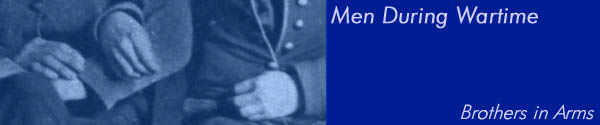
The picture shows Jechonias P. Willis on the left, a clerk who enlisted
in the Confederate army at the age of 22 in May, 1861. He is shown with
17-year-old Pvt. Thomas W. Lindsay. Willis was killed at Fort Macon,
Georgia in April, 1862, where Lindsay was taken prisoner until August,
1862. (Source: Richard B. McCaslin, Portraits of Conflict: A Photographic
History of North Carolina in the Civil War, 249.)
Mitchell Reid in The Vacant Chair conveys a story about how
the gender roles of camp life complicated mainstream notions of masculinity:
Dye Davis, a soldier in the 48th Pennsylvania Volunteers, liked to
drink and brawl. James Wren, his captain, appealed to notions of manhood
to domesticate Davis. After one drunk, Davis sobered up to find himself
tied to a board. He requested that the captain come to him, but Wren
put the soldier off. When Wren finally did visit Davis, he told him
he would not release him from his humiliation: "You told me before
that you would keep sober and be a man. There's no man in you." Davis's
reply was not a denial of the charge or a promise to reform. Instead,
he cried out, "O what would my Mary say if she saw me here?" That,
Wren approvingly noted, was when Davis "commenced to be a [man]."
The captain seized the moment and used Davis's insecurity about his
manhood. Wren told Davis, "What would your Mary--your Mary would be
just like me. When she married you, she thought she had a man and
when I enlisted [you] I thought I had a man, but we were both mistaken."
Weeping, Davis now told the captain, "[I] will show you I will be
a man." The captain judged Davis to have kept his promise--he was
wounded three times and killed at the Wilderness. "A braver and better
soldier than Davis was not to be found in the service . . . but his
Mary was the great coard [sic] to be touched." (13)
By the end of the story, Davis's relation to the Captain and to his
wife Mary are made analagous. Who makes this analogy in the story? Davis?
The Captain? How does it come about?
close
window
|