|
|
|
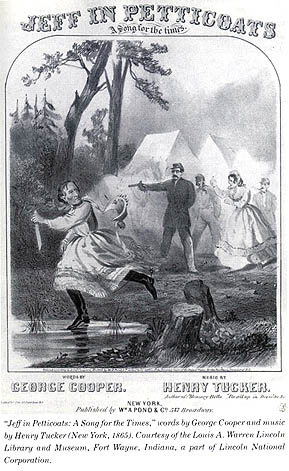
Nina Silber has written extensively on the contingencies of gender during the Civil War. Discussing similar cartoons showing Jefferson Davis, the Confederate President, dressed as a woman, she notes that "Davis became a symbol for all the southern rulers' deceptive claims to manliness and chivalric courage. Davis proved false the assertions of southern leaders who had boasted of their more civilized society, their greater concern for the weaker sex, their military prowess, and their manly courage. Because these assertions of masculinity had become defining characteristics of the southern aristocrat, a blow aimed at Jefferson Davis's manliness also targeted the southern "chivalry's" class pretenses" ("Intemperate Men, Spiteful Women, and Jefferson Davis," 297-8). Silber summarizes by noting that "[i]n both the antebellum and postbellum dialogue, gender served as a central metaphor in the sectional debate between the North and the South. Implicit in Northern men's free-labor ideology, and their free-labor critique of the South, was an understanding of two competing notions of masculinity--one rooted in hard work and moral self-restraint, the other mired in slavery, aggression, and vice. The northern victory in the Civil War thus seemed to many a final affirmation of northern men's superior model of manliness. In contrast, the southern system seemed to rest on a foundation of gender corruption where whining, nervous men marched into battle and spiteful, angry women set the political agenda. Even the president of the Confederacy had revealed that neither southern men nor southern women understood the proper boundaries for gender behavior" (304). |