| This text comes from A Brief Plea For An Ambulance System
For The Army Of The United States, As Drawn From The Extra Sufferings
Of The Late Lieut. Bowditch And A Wounded Comrade. By Henry I. Bowditch,
M. D., Professor Of Clinical Medicine In Harvard College.
Note that this pamphlet, written by a father about the sufferings of
his son, was published by the same publishers, Ticknor & Fields,
who were also issuing editions of classic American authors like Nathaniel
Hawthorne.
. . .May I not believe that now I can, of myself, exert a greater
moral influence upon those in power, and that I can now do something--as
all my previous efforts seem to have been vain--toward persuading
the authorities to take some measures, that will secure to our wounded
soldiers the Nation's fostering care, from the first moment of their
fall upon the bloody field, until they arrive in our well supplied
and most excellent hospitals.
This is not the case at present; for, under the want of all proper
arrangements by the Government, a wounded soldier is liable to be
left to suffer, and die, it may be, on the battle-ground, without
the least attention, save what common humanity would lead one soldier
to bestow upon a comrade.
. . .
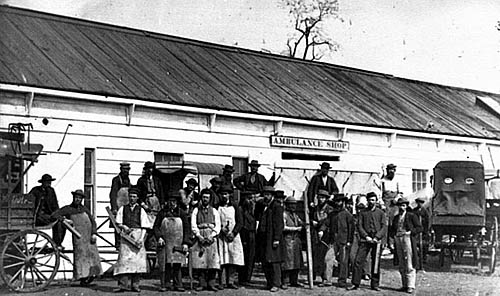
As an illustration of, and in addition to what has been already published
by others, as well as by myself, I beg leave to state that Lieut.
Bowditch, having been mortally wounded, in the first charge made after
leaving Kelly's Ford, lay helpless on the ground, for some time, by
the side of his dead horse. Two surgeons saw him, but they evidently
had no means for carrying off the wounded officer, and it is believed
no one connected with an Ambulance Corps ever approached him there
. . . . (6-7)
|